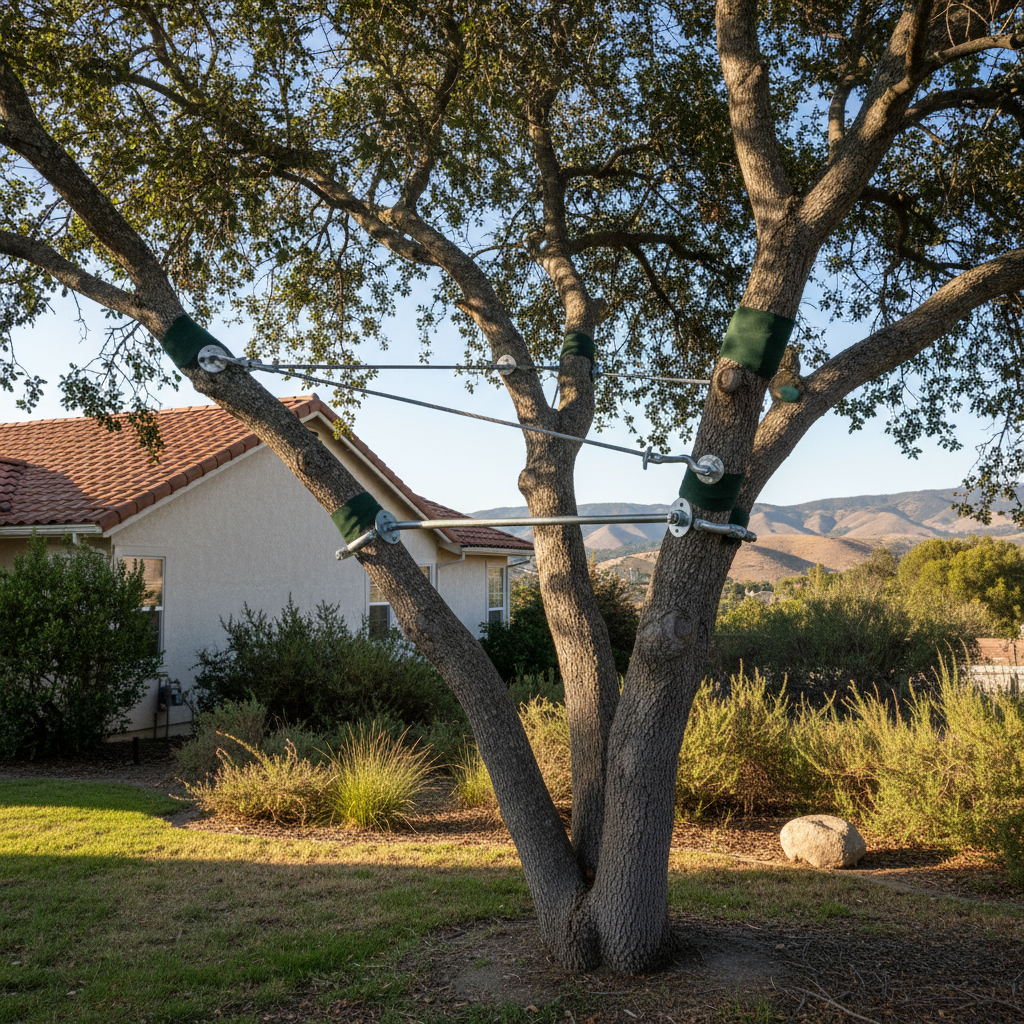
So, you've got a tree on your property that's been cabled or braced. Maybe it's a beautiful old oak with a split trunk, or a eucalyptus that's grown a little too wide for its own good. Whatever the reason, that cabling or bracing was put in place to keep your tree safe, stable, and healthy for years to come. But here's the thing: it's not a 'set it and forget it' kind of deal. Just like anything else, these systems need a little love and attention to do their job right, especially with our coastal weather.
Extending the Life of Your Cabling & Bracing
You want that investment to last, right? The biggest thing you can do is stay proactive. Regular check-ups are key. Think of it like changing the oil in your car. You wouldn't just drive it until it breaks down, would you? The same goes for your tree's support system.
Here in Grover Beach, we get some pretty strong winds, especially during winter storms. Those gusts can put a lot of stress on cables and braces, even well-installed ones. The salt air doesn't help either; it can accelerate corrosion on metal components if they're not properly maintained or if their protective coatings get damaged. So, keeping an eye on things after a big blow is crucial.
What Regular Maintenance Looks Like
For most homeowners, 'regular maintenance' means a visual inspection a few times a year. Walk around your tree and really look at the hardware.
- Check the cables: Are they taut? Not too tight, not too loose. They should have a slight give, but not be sagging. Look for any frayed strands, kinks, or signs of rust, especially where they connect to the eye bolts.
- Inspect the bolts and anchors: Are they still firmly seated in the tree? Is the bark growing around them naturally, or is it getting pinched or damaged? Sometimes, as a tree grows, the hardware can start to get embedded too deeply, which can cause issues.
- Look at the bracing rods: If you have through-rods, check the nuts and washers on the outside of the bark. Are they still snug? Is there any excessive rust?
- Examine the tree itself: Is the supported limb looking healthy? Any new cracks forming near the hardware? Is the tree growing in a way that's putting new, unexpected stress on the system?
A good time to do this is in the spring after the winter storms, and then again in late summer or early fall before the next storm season kicks in. It only takes a few minutes, and it can save you a lot of headaches down the road.
Warning Signs You Shouldn't Ignore
These are the red flags that tell you something's not right and you need to act fast:
- Sagging or loose cables: If a cable is visibly slack, it's not doing its job. This often means the tree has shifted, or the anchor point has failed.
- Broken strands or hardware: Any visible damage to the cable itself, or if a bolt has pulled out or snapped, that's an immediate problem.
- Excessive rust: A little surface rust might be okay, but if it's deep or flaking, the integrity of the metal is compromised.
- Bark damage around hardware: If the tree's bark is splitting, peeling, or showing signs of decay right around where the cables or rods are attached, the hardware might be girdling the tree or allowing moisture in.
- New cracks or splits: This is a big one. If you see new cracks forming in the supported limb, or if an existing crack is getting worse despite the cabling, the system might be failing or the tree's condition has deteriorated.
- Unusual tree movement: If the tree seems to be swaying more than usual in the wind, or you hear creaking noises coming from the supported areas, that's a serious warning sign.
Remember, your trees, especially those in the sandy soils near the dunes in Grover Beach, can be quite resilient, but they still need help when they're structurally compromised.
When to Call a Professional
If you see any of those warning signs, don't try to fix it yourself. Tree cabling and bracing is specialized work. You need someone who understands tree biology, structural mechanics, and proper installation techniques. That's where a professional arborist comes in.
You should also call us at Classic Tree for an annual inspection, even if everything looks fine to you. We can spot subtle issues you might miss and make adjustments before they become major problems. We'll check the tension, assess the tree's growth in relation to the hardware, and make recommendations for any necessary adjustments or upgrades. Sometimes, a tree grows so much that the original system needs to be expanded or replaced.
Keeping an eye on your cabled and braced trees is a small effort that pays off big time in terms of safety and the longevity of your beautiful trees. Don't wait until there's a problem; be proactive, and your trees will thank you for it.